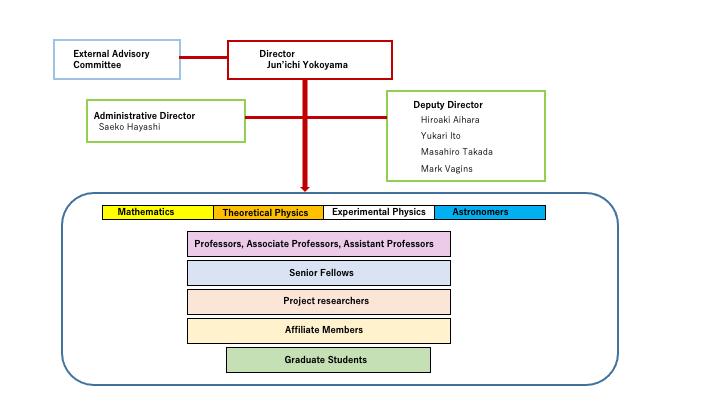
The Kavli IPMU is the first entity within the University of Tokyo Institutes for Advanced Study (UTIAS). The Kavli IPMU Director is appointed by the Director of UTIAS. The Director has complete authority and responsibility of making a wide range of decisions including institute management and appointment of research staffs and administrative staffs. The Kavli IPMU Steering Committee (SC), consisting of the Director, Deputy Directors and the Administrative Director and a couple of PIs, serves as the personnel committee for faculty and reports the decisions to the UTIAS Steering Committee. The Executive Board (EB) is held regularly to ensure smooth operation and swift decision making on daily matters.
The External Advisory Committee (EAC), appointed by the University President, reviews annually the scientific achievement and activities of the Institute and advises the President on scientific priorities and the research activities to keep the Institute stay on the course of their objectives.
Kavli IPMU grants the title of Senior Fellows to those who have received high international recognition for their academic or educational achievements in their respective fields and contribute to the promotion of research activities at Kavli IPMU.
The administrative staff is an integral part of the Institute. Providing the best possible environment to the researchers in the institute is essentially important for the Kavli IPMU's mission. This part is headed by the Administrative Director. Its function also enables the Director to spend more time to consider the institute at large and focus on the direction of the research.
Kavli IPMU Organization Chart (April 1st, 2025)
External Advisory Committee Members
- Joshua FRIEMAN (KICP, U. Chicago, USA) Chair
- Shin'ya AOKI (RIKEN, Japan)
- François BOUCHET (IAP, France)
- John ELLIS (King's College, London, UK)
- Shirley HO (Flatiron Institute and Princeton U, USA)
- Sakura SCHAFER-NAMEKI (Oxford U, UK)
- Yongbin RUAN (Zhejiang U, China)
- Michitoshi YOSHIDA (NAOJ, Japan)
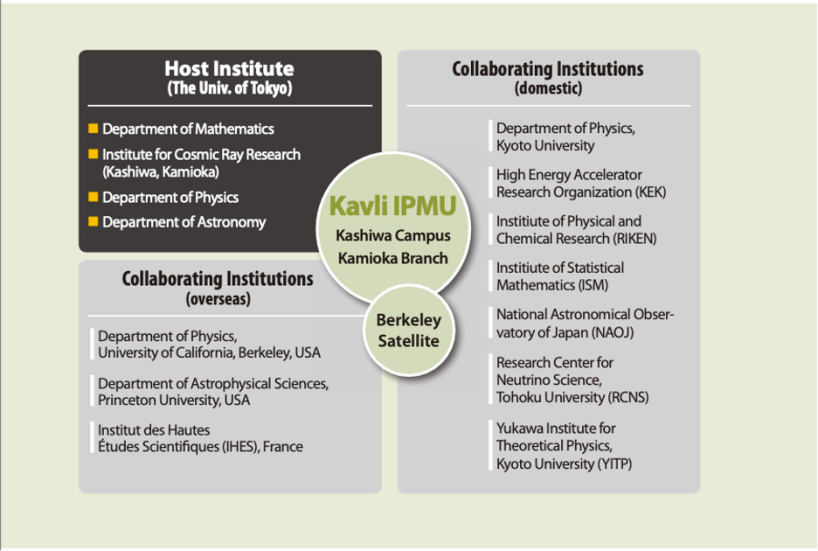
Host Institute (Univ. of Tokyo)
- The University of Tokyo Institutes for Advanced Study (UTIAS)
- Department of Physics, Faculty of Science & Graduate School of Science
- Institute for Cosmic Ray Research (Kashiwa and Kamioka)
- Graduate School of Mathematical Sciences
- Department of Astronomy
Collaborating Institutions
- National Astronomical Observatory of Japan (NAOJ)
- Department of Physics, Kyoto University
- Yukawa Institute for Theoretical Physics, Kyoto University
- Research Center for Neutrino Science, Tohoku University (RCNS)
- Department of Physics, Univ. of California Berkeley
- Department of Astrophysical Sciences, Princeton University
- Institut des Hautes Études Scientifiques (IHES) in France
- High Energy Accelerator Research Organization (KEK)
- Institute of Physical and Chemical Research (RIKEN)
- Institute of Statistical Mathematics (ISM)
Foreign institutions/consortia/programs having MOU with the Kavli IPMU
- The University of California, Berkeley, Department of Physics
- Princeton University
- The University of Chicago
- Johns Hopkins University
- Le Centre National de la Recherche Scientifique (CNRS)
- Universidad de Guadalajara
- Garching/Munich Cluster of Excellence on “The Origin and Structure of the Universe”
- The Astrophysics Research Consortium [on the Sloan Digital Sky Survey III ]
- National Taiwan University, Leung Center for Cosmology and Particle Astrophysics (LeCosPA)
- Deutsches Elektronen Synchrotron (DESY)
- UNIFY (Unification of Fundamental Forces and Applications) [under the EU’s Seventh Framework Program]
- The Scuola Internationale Superiore di Studi Avanzati (SISSA)
- The Astrophysics Research Consortium [on the Sloan Digital Sky Survey AS3 (“After SDSS III”)]
- TRIUMF (Canada’s National Laboratory for Particle and Nuclear Physics)
- The Tata Institute of Fundamental Research
- Tshinghua University, The Mathematical Sciences Center
- Steklov Mathematical Institute, Russian Academy of Sciences
- The Intermediate Palomar Transient Factory (iPTF)
- The Astrophysics Research Consortium [on the Sloan Digital Sky Survey IV ]
- The Academia Sinica Institute of Astronomy and Astrophysics of Taiwan (ASIAA) [on the SuMIRe Project]
- The University of Oxford, Department of Physics
- Lawrence Berkeley National Laboratory
- The Kavli Institute for Astronomy and Astrophysics at Peking University (KIAA)
- The Mainz Institute for Theoretical Physics (MITP)
- Fermi Research Alliance
- Walter Burke Institute for Theoretical Physics, the California Institute of Technology
- The University of Bonn
- European Research and International Cooperation Department of CNRS (DERCI)
- University of Science and Technology of China
- Perimeter Institute for Theoretical Physics
- Tongji University, School of Physics Science and Engineering
Other Links
- Department of Mathematics, Kyoto University
- Department of Physics, Nagoya University
- Caltech Particle Theory
- Department of Physics and Astronomy, U.C. Irvine
- Universite' Paris Diderot (Paris 7)
- Research Institute for Mathematical Sciences, Kyoto University
- Leung Center for Cosmology and Particle Astrophysics (LeCosPA)
- Astrophysical Research Consortium (SDSS3)
- Excellence Cluster Universe
- Kobayashi-Maskawa Institute for the Origin of Particles and the Universe (KMI), Nagoya University